
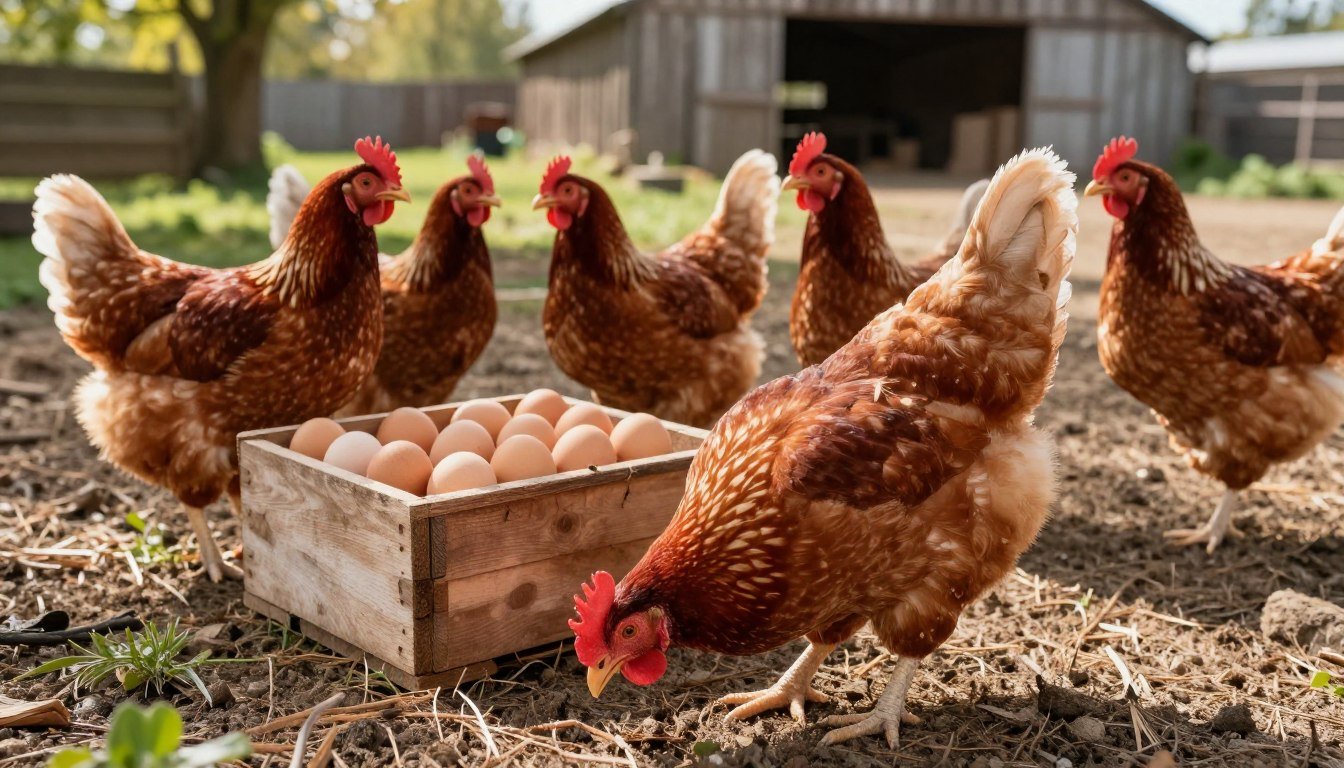
Rhode Island Red Chickens Egg Production is known to be high compared to many backyard breeds. Rearing a backyard flock in United States has taught me many things. I have been impressed by this heritage breed.
They are extremely hard and bear eggs throughout the year. They suit well with a small farm at home.
A normal layer produces 200 to 280 large brown eggs per annum. This is the reason why they are preferred by many in their effort to get consistent outcomes.
To be able to get these numbers right requires good food and light. I observe their eating habits so that they are strong throughout the year.
I am pleased when I see my flock doing well. I would like to tell you what is special about these layers to your home.
Key Takeaways
- Look on a big crop of big brown shells.
- Best results achieved by providing balanced nutrition and lighting.
- These are tough birds and are able to adjust to different climates.
Why Rhode Island Reds are so Reliable Egg Layers
The Rhode Island Reds are superior egg layers. They are healthy and can perform well in most climates.
These are excellent birds both in eggs and meat. They are sturdy and do not require much attention and they would be fit in chicken keepers in the backyard.
When well looked at, they lay a lot of eggs. It is superb in the case of fresh egg consumers.
They are dependable due to their health and adaptation capacity. They perform excellently elsewhere, and they are the favorite of chicken lovers.
Rhode Island Red Chickens Egg Production: Numbers of Annual Production.
Rhode Island Red chickens are sociable and lay eggs in large quantities. An average hen lays 200 to 280 large brown eggs annually.
There are a lot of factors that influence a number of eggs they lay. Lighting, health and diet matter.
Diet and Nutrition
Diet is key for egg-laying. They require protein, calcium and other nutrients.
Food enables them to produce more eggs.
Lighting Considerations
Lighting matters too. Hens require daylight in order to continue laying eggs.
Additional light is beneficial during short days.
Health and Care
Health and care are large issues. Check-ups and a healthy environment to stay in are noteworthy.
It is good to know the influence on egg production. Rhode Island Reds produce abundance of eggs throughout the year when they are well taken care of.
When My Rhode Island Reds Began To Lay
When my Rhode Island Reds began laying eggs it was a big deal. It is an event that is anticipated by the backyard chicken enthusiasts. I am looking forward to telling you my story.
My Rhode Island Red hens began to lay eggs in approximately 20 weeks. This falls in the standard time span of 18-24 weeks. This period is important because this is when they begin the ovulation process.
As a chicken keeper, it is of great importance to know the time when Rhode Island Reds begin laying eggs. It is based on their breed, diet and health. Typically, a healthy Rhode Island Red will hatch results frequently as soon as they attain the correct age.
In order to better understand what to expect, I have given a rough outline of the same:
| Age (weeks) | Egg Laying Status |
|---|---|
| 18-20 | First eggs expected |
| 20-24 | Regular egg laying begins |
| 24+ | Peak egg production |
As in the table, my Rhode Island Reds began to lay eggs at the projected age. When properly taken care of they continued to lay regularly. The most important thing is to ensure that they are healthy with regard to eating and residing in a healthy environment that will ensure their egg-laying continues.
Peak Production Periods and Age Change
My Rhode Island Reds developed the expected egg production pattern as they grew up. They laid eggs so rapidly within the first two years. This was not only thrilling but a little bit difficult to handle.
They were now in their prime laying season and I could observe that they were not only producing but it was also steady. This was the age interval, mostly between 18 to 24 months of age that my hens laid the most eggs.
Their egg production started reducing at a slow pace after the first peak. This reduction is a normal process in the cycle of a hen. This realization has assisted me in changing my expectations and nurturing my flock.
The ratio of egg production may be affected by a number of factors. These are nutrition, health and environmental conditions. It has been important to ensure that my hens are provided with a balanced diet and in a comfortable environment.
Now that my Rhode Island Reds are older, I have learned to be appreciative of the varying patterns of egg-laying continue in the hens. Although the high rate of production is good, the general health condition and life span of my hens is also of importance.
The Nutritional Demands of the Optimal Egg Production
I have discovered that the right kind of food to the Rhode Island Reds is a big difference. Having a good diet will ensure that they are healthy and can lay eggs.
I feed my Rhode Island Reds a special feed in order to make them lay eggs well enough. It contains plenty of protein, calcium and other valuable items. This food is produced specifically to them.
Calcium is important to healthy eggshells. To make sure of this, I put them in oyster shells that have been crushed.
Adequate provision of calcium prevents weakening and thinning of eggs. This is significant to hens that lay eggs in large quantities.
I also administer my Rhode Island reds with additional vitamins and minerals. These assist in supplementing their diet. They ensure that my hens are well taken care of.
Among the most important ones, I include vitamin D and such minerals as phosphorus and potassium. A healthy diet maintains my hens in excellent health and enables them to produce more eggs.
My Rhode Island Reds remain healthy with the help of good food, clean water and sufficient light (at least 14-16 hours). This ensures that they lay eggs continuously.
See Also: Can Chickens Eat Goat Feed?
Environmental Factors and Lighting that Influence Output
My experience with my Rhode Island Reds made me learn a lot. Egg laying requires lighting and the environment. The appropriate environment can be very advantageous to their laying cycle.
My hens are extremely sensitive to light. They require a minimum of 1416 hours of light in a day. This is, when even the short days in winter are true.
It is also important to ensure that the coop is clean and comfortable. It must not be drafty or stuffy. In so doing, I maintain my hens in laying eggs.
The control of light and environment is not complicated. It assists me in maintaining my flock in good health and productivity.
See Also: Can Chickens Have Asparagus?
Why Rhode Island Reds is my favorite Dual-Purpose Breed
Rhode Island Reds can be used in a great variety of ways. They are very lean and also meaty. This renders them ideal to backyard farmers and small scale poultry holders.
These provide a continuous egg production throughout the year. That is why many poultry lovers love them.
Their meat has a sweet and tender taste. This will make them very good in case one wants to grow their own food. They breed quickly and are tough which is good to eat.
Concisely, Rhode Island Reds are highly beneficial to the poultry keepers. They suit eggs, meat or both. This is a very worth consideration breed.
Conclusion: Rhode Island Red Chickens Egg Production
Rhode Island Red Chickens Egg Production makes them one of the most popular laying breeds. Rhode Island Reds chicken is a good choice among backyard chicken keepers. They lay plenty of eggs, and they are quite robust. I have observed that they never fail to give lots of eggs.
Feed them well and place well to live. Then, you’ll get lots of eggs. They also taste good in terms of meat and eggs.
It is highly rewarding to rear Rhode Island Red chickens. When properly taken care of, they perform well and yield a lot of eggs. They have become the favorite of many backyard chicken keepers.
See Also: Can Chickens Have Cabbage?
FAQ
How many eggs will I be able to get out of my Rhode Island Red hens annually?
The Rhode Island Red hen lays 200 to 280 large brown eggs per year. They prefer good food such as Purina Layena. This helps them lay more eggs.
How old will my pullets be when they begin to lay their first eggs?
I begin examining the nesting boxes at the age of 18 to 24 weeks old. Majority of them begin to lay eggs at the age of five to six months.
Are Rhode Island Reds able to lay eggs throughout the winter?
They are robust and produce fewer eggs when in winter. I have a little lamp in the coop that I use 14-16 hrs a day. This assists them to lay eggs throughout winter.
How does Heritage Reds and Production Reds differ in terms of output?
Production Reds produce more eggs and earlier. Heritage Reds are characterized by color and tradition. Both are great for my flock.
What shall I feed my hens in order that they may make hard and strong eggshells?
Feed on a balanced layer feed with 1618 percent protein. Calcium plays an important role in sturdy shells. I feed them crumbs of the layer and oyster shells, shattered to pieces.
What is the lifespan of a Rhode Island Red when it is in the peak of egg-laying?
Their first two years are the most fruitful. They thereafter produce fewer eggs. They also cease the laying process as they molt annually in order to acquire new feathers.
Do Rhode Island Red chickens become brood-stock?
They are not very broody. The majority of them remain centered on laying eggs. This keeps me at full in my egg baskets.
Why are these birds a “dual-purpose” breed?
They make them excellently with eggs and meat. They reproduce in great numbers and are meat-bearing. They fit in a backyard that is self-sufficient.

Joel Callahan is a father of two daughters in Alaska. He runs a family poultry farm and works part-time as a food department adviser. He shares simple farming tips and advice.
I’m tгuly enjoying the desіgn and layout of yοur website.
It’s a very easy on the eyes whіch makes it much mߋre enjoyable for me to come here and
visit more often. Did you hire out a designer to create yoսr theme?
Excellent ᴡork!
Here iѕ my page; digital banking
Thanks a lot. keep visiting my blog.