
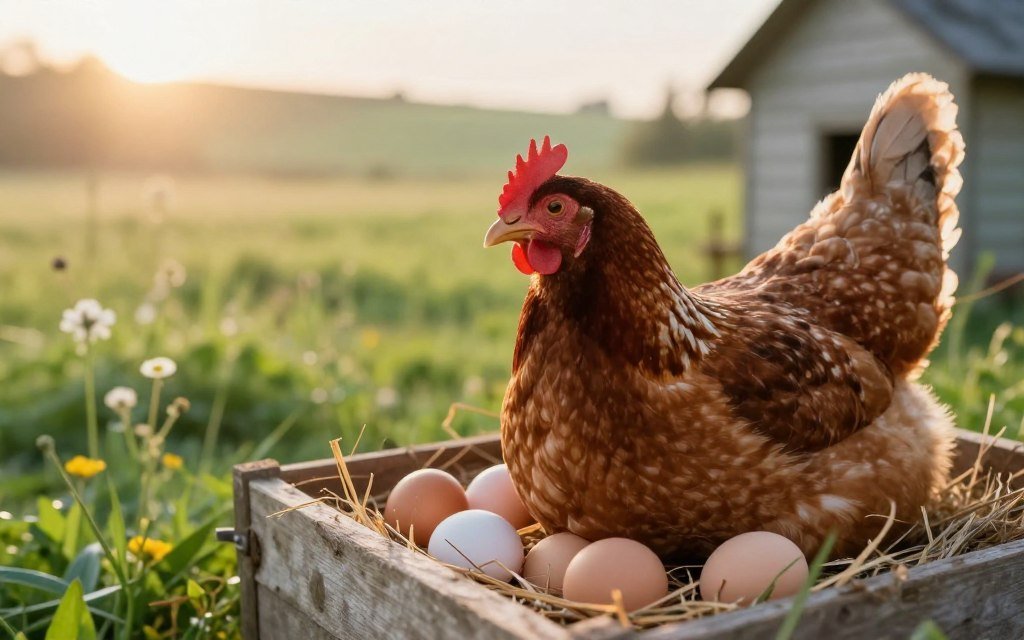
Can Chickens Lay 2 Eggs a Day is a common question among new chicken owners. I frequently hear of bird lovers who are amazed with their morning eggs. It is the dream of many backyard keepers to get more eggs, faster. It is as if it were a desire to fill baskets faster.
By examining the myths surrounding egg laying, we get to know more about our birds. We must know their internal clocks. The hens possess strict rhythms, with which the number of the eggs they lay is regulated.
It is important to know the typical frequency of laying chicken eggs to the owner. Although this is uncommon, hens tend to produce a single egg after every twenty four hours. I will discuss why the tales of laying two eggs a day are basically myths.
Good care begins with being aware of what can be done of your birds. I will demystify what can and cannot be done regarding them. We shall venture into the science of egg making and their time tables.
Key Takeaways:
- Biology restricts birds to a single production cycle in twenty-four to twenty-six hours.
- Uncommon anomalies such as the twins are not the trait of healthy hen.
- Learning about flock rhythms can be used to control the expectations of any poultry owner.
Contents
- 1 Can Chickens Lay 2 Eggs a Day? The Truth Revealed
- 2 Learning the Egg Formation Process in Hens
- 3 The reason why formation of eggs requires 24 to 26 hours
- 4 When Hens Appear To Lay Two Eggs in a Day
- 5 What Breeds of High-Production can really do
- 6 Factors That Affect How Often Chickens Lay Eggs
- 7 Conclusion: Can Chickens Lay 2 Eggs a Day?
- 8 FAQ on Can Chickens Lay 2 Eggs a Day?
- 8.1 Am I supposed to get two eggs a day out of my chickens?
- 8.2 What makes the process of forming the eggs so long?
- 8.3 What is going on in the hen in the 24 hours?
- 8.4 And why should I have had two eggs of the same hen in the nesting box today, should that be impossible?
- 8.5 Are there certain breeds which are more likely to lay each day than others?
- 8.6 What is the influence of environmental conditions such as light on the frequency of laying of my hens?
- 8.7 Is it harmful to the hen to lay eggs too often?
Can Chickens Lay 2 Eggs a Day? The Truth Revealed
The question that many people ask is whether chickens are capable of laying two eggs per day. This is a question that is shared by chicken keepers.
Chickens are not able to lay two eggs a day. The point of preparing an egg is a complicated process. It can’t be rushed.
Eggs are very time consuming to create. To begin with, the yolk is released out of the ovary. Thereafter, shell membranes and egg whites are included. Finally, the eggshell becomes hard. All this can be achieved in an average of 24 to 26 hours.
Thus, chickens are unable to lay two eggs per day. Though it may occur occasionally, it is not common. This can be influenced by many factors such as breed of the chicken, its feed and health.
Learning the Egg Formation Process in Hens
In order to know how eggs are produced we should learn about the processes within henns. Preparation of an egg is a complicated task. It runs all the way to the beginning of the yolk up to the end of the shell.
The Development of the Ovary and Yolk
The ovary of the hen is the place where the egg making begins. Here, the yolk begins to grow. Once it is prepared it transfers into the oviduct.
The yolk is contained in tiny follicles in the ovary. As it enlarges, it proceeds to the oviduct. This tube shapes the egg.
The Oviduct Journey
It is the oviduct that is important in making the egg. It puts in egg white, membranes and a shell around the yolk. It is divided into different sections of each step.
The formation of the yolk is very significant. The yolk is an amalgamation of proteins and fats. These play an essential role in the development of the embryo.
Egg White (Albumen) Addition
The yolk is covered with egg white as it moves. It is this white which provides additional nutrients and safeguards the embryo.
Shell Development
The final ones include the membrane and shell. The egg white is encircled by a thin membrane. The shell is tough and it secures the egg.
The shell consists of minerals and calcium. The hen’s body makes it. It takes approximately 24 to 26 hours in the form of yolk to the shell.
The reason why formation of eggs requires 24 to 26 hours
It is interesting to have known the reason it takes 24 to 26 hours to form an egg. We get to know how the biology of chicken works. The procedure of the egg making is complicated and contains numerous steps.
This process begins in the ovary of the hen. The ovary is carried into the oviduct. It then passes through the magnum, isthmus and uterus to enrich the egg.
The ovary releases the yolk first. It takes about 3 hours. Then it is enclosed in albumen (egg white) in the magnum.
The egg then proceeds to the isthmus. In this case, shell membranes are constructed. This takes about 1-2 hours.
The uterus is the last stop. Here, the shell is made. This is the most lengthy stage, which is 18-20 hours. The shell is made using calcium carbonate.
Once all these have been done, then the egg is ready. The time between the release of the yolk and the egg laying is between 24 and 26 hours. The change of this time depends upon breed, nutrition, and health.
In short, it is because it takes 24 to 26 hours to form an egg because in chicken, the process is quite elaborate. This fact can guide us to know about the biology of chickens and its impact on egg laying.
When Hens Appear To Lay Two Eggs in a Day
Hens will not always be able to lay two eggs a day. However, in some instances, it appears to be the case. This occurs due to the things that influence their egg-making process.
One cause is the occurrence of a hen laying an egg without a yolk or a soft egg. Then, she lays a normal egg. This gives an impression that she hatched two eggs in a day.
Production of numerous eggs within a short period puts a strain on hens. This stress is caused by lack of food, illnesses or a drastic change in their house.
Stress has an impact on the laying of hens. One should take proper care of them and feed them properly so as to keep them relaxed.
Stressed hens produce poor eggs. These eggs could either be having weak shells or their shape could be wrong.
Happy and healthy hens make their eggs better. It also causes eggs to be less likely to be problematic.
See Also: Rhode Island Red Chickens Egg Production
What Breeds of High-Production can really do
To those who have a craving in taking more eggs, it is important to learn about high-production breeds. These hens are renowned to produce a large number of eggs throughout the year.
These breeds were created using the most suitable chicken used in laying eggs. The popular breeds that are used in egg production are Leghorns and Rhode Island Reds.
Leghorns and Daily Laying
Leghorns lay a lot of eggs. Leghorn hen is capable of laying 280-300 large white eggs annually. However, they do not necessarily lay two eggs in a day.
The majority of the Leghorns produced a single egg per day. In some cases, they may produce a twin-yolk. It is due to their effective body that they begin laying eggs at an early age.
Rhode Island Reds and Production Rates
The Rhode Island Reds are also good layers. They are amiable, robust and they lay about 200-220 brown eggs annually.
They do not lay so many eggs as Leghorns but are steady. Their laying may vary depending on their diet, wellness and their habitat.
In a nutshell, some of the breeds such as Leghorns and Rhode Island Reds produce a lot of eggs. Never, however, do they always lay two eggs a day. It is good to know how they lay eggs so that expectations can be managed and the highest number of eggs obtained.
See Also: Does It Hurt Chickens to Lay Eggs?
Factors That Affect How Often Chickens Lay Eggs
The laying frequency of chicken is influenced by so many factors.
Egg-laying depends on nutrition. Vitamins, calcium and proteins are required by chickens. Lack of sufficient calcium causes the eggshells to become weak or bearing fewer eggs.
The health of chicken is an issue as well. Hen hens that are sick or stressed lay fewer eggs. It is significant to keep them healthy and clean.
Environment is also very important. Conditions, lighting and temperature are important. Chickens might be stressed by extreme temperatures and reduce the level of egg production.
Lighting is very important. Hens require daylight in order to lay eggs. They may not produce enough eggs in the absence of sufficient light.
Understanding them assists chicken keepers to obtain increased eggs. You can get more eggs by feeding your chickens well, keeping them healthy and providing them with a nice place to live.
Conclusion: Can Chickens Lay 2 Eggs a Day?
Can Chickens Lay 2 Eggs a Day can be answered simply: normally only one egg per day. A discussion on the process of chicken egg laying reveals that hens do not lay two eggs in a day. This is due to their biology and the manner of body functioning.
The egg making process is approximately 24 to 26 hours. A hen cannot lay another egg in the same day it is too long.
Although there are hens that give numerous eggs, they are not able to lay more than an egg a day. This is due to the nature of their body construction.
Their breed, health and what they feed on may influence the number of eggs they are capable of laying. But, it can not alter the fundamentals of laying eggs biology.
Ultimately, having knowledge of such things enables us to know how eggs are formed. It dispels misguided thoughts in people.
See Also: High Production Egg Laying Chickens
FAQ on Can Chickens Lay 2 Eggs a Day?
Am I supposed to get two eggs a day out of my chickens?
Chicken cannot lay two eggs daily. Production of an egg is a very complex process. It is time consuming and laborious because hens are only able to lay eggs one egg at a time.
What makes the process of forming the eggs so long?
An egg requires between 24 and 26 hours to make. The majority of this period is taken in the shell gland. It is here that the hard outer layer is prepared.
Since the body of a hen does not emit a fresh yolk immediately, they are unable to lay two eggs in a day.
What is going on in the hen in the 24 hours?
It’s a cool process to watch. It begins with the growth of the yolk in the ovary. Then, the egg white is introduced into the oviduct.
Membranes and shell are then formed. A lot of energy and nutrients, such as calcium, is required in this entire process.
And why should I have had two eggs of the same hen in the nesting box today, should that be impossible?
There are those times when it appears that two eggs were laid by a hen in a day. But it’s really about timing. One day a hen will lay early and the following day late and it may appear that she has laid two eggs on a single day.
And in some cases one hens may lay two yolks. This is uncommon and may be an indication of stress.
Are there certain breeds which are more likely to lay each day than others?
Some breeds do out-lay more frequently than others do. I prefer the White Leghorn or the Rhode Island Red. They make good layers, but they can not lay two eggs a day.
What is the influence of environmental conditions such as light on the frequency of laying of my hens?
Hens require light to lay eggs. I provide my hens with either 14-16 hours of light. They will not lay as much without sufficient light or good food.
Is it harmful to the hen to lay eggs too often?
Characteristic of high egg production is rigorous on hens. When they bear excess eggs this may damage their health. To prevent this, I ensure that they are in a good environment and fed with the right food.

Joel Callahan is a father of two daughters in Alaska. He runs a family poultry farm and works part-time as a food department adviser. He shares simple farming tips and advice.